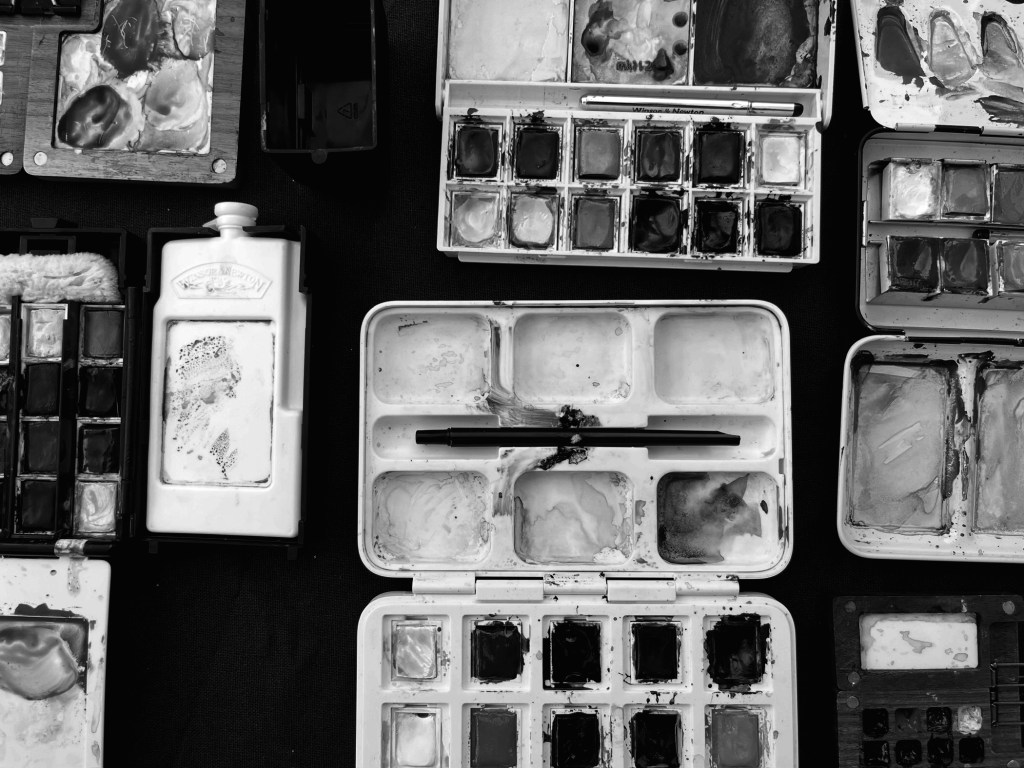
The best art supplies are the ones you have on you. If you don’t, I hope this article will help you choose what you’re looking for. I rounded up swatches of my favorite supplies that I have at hand to illustrate just how different and unique they all are. I’ve always been looking for a post like this, and as I could find none, why not create one?
My process of selecting the best art supplies relies heavily on research and recommendations from artists I admire. Some tools simply feel like magic the second they touch paper, and those are the art supplies I consider ‘best’ or my favorite.
The journey I took was a long one, and as a result, there is quite a lot of clutter in my apartment. But I’ve learned to be more selective – I now always know what I’m looking for and why. And there’s a ton of content out there that can help you choose your art supplies in a clever, non-wasteful way (unless you’re looking for a fountain pen with a flexible nib!).
The right art supplies make all the difference
Some will whine and say that it’s not about the tools you use – it’s about you, the artist. But I’d beg to differ. I encourage exploration with art supplies because they will always take you one step further with your craft, or at least serve as grounds for experimentation. You know how each different pen changes your handwriting? Each art tool forces you to draw and see things differently.
In seeing things differently, you’re inclined to experiment more and more. I’m not encouraging splurging on art supplies, but I am encouraging you to have some staple basics in your arsenal to try and test in your sketchbooks. See where they take you!
The right materials can also unlock new techniques, endless joy, and give you more confidence as an artist. You may not know how to use your new tools at first, but you just have to go with your gut and see where they take you next. I always ‘break into’ my tools by testing them first on the type of paper I’m using. Helps me get over the intimidation.
For instance, I’ve always overlooked something as simple as color pencils for sketchbooks. I’ve always used watercolors to add color. But colored pencils gave me soo much room to explore and be quick while I’m at it. You don’t have to wait for them to dry, and it’s easy to layer other materials on top. It changed how I sketch on a daily basis – and I’m free to interchange between beloved watercolors and pencils. Sometimes I use both.
My on-the-go art supplies setup
I want to start with a small note on the art supplies I carry with me wherever I go. The setup is quite simple. I have 2 types of pens (thin, thick), pocketable watercolors, and an A6 sketchbook.
Here is what I carry in my bag:

The pens I use are:
- Pilot G-TEC-C (maica): Wonderful for very thin lines and detail work. It is a gel ink pen, so it does tend to bleed a bit with water. Beautiful pen for writing, by the way.
- Uni-ball (eye) micro: A very smooth gel ink pen (which also bleeds a bit) but the experience of drawing with both of these is exceptional.
The sketchbook I carry is a simple Leuchtturm1917, A6 size. The pocketable watercolor set I bought on Amazon—here is the link. I got quite a few questions about it because it’s so cute and unusual to see watercolors in this format! It fits in just about any pocket, but the variations of similar products is quite vast. I’ve seen really neat card-holder sized watercolor sets as well.
You do have to fill the paint palettes yourself. I used the White Nights tubed watercolors I had from a long time ago. Any watercolors work really, as long as they come in a tube.
The art supplies that changed how I create
1. Sketchbooks and paper
When it comes to paper, I’m not picky. For more than a decade now, I’ve used the Leuchtturm1917 sketchbooks. The paper is really thin, but I recently discovered that there’s a limited edition line that has 120gsm paper. That’s the one I use now, and I find it perfect for my daily needs.
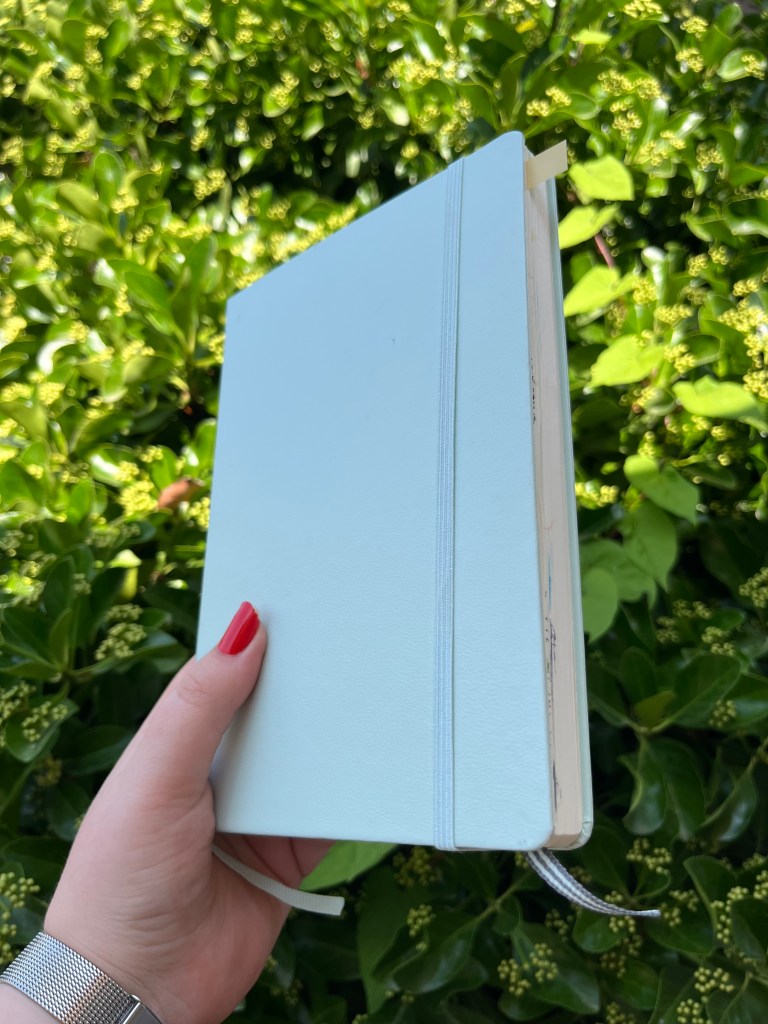
If you plan to work with paint or watercolor, I suggest you go for something a little bit thicker in terms of paper. I recently discovered Etchr which does all kinds of sketchbooks for artists, and the paper is excellent (hot pressed!). I won’t have time to get into cold pressed vs hot pressed, but know that hot pressed is generally smoother.

My most recent purchase (after many recommendations to get this one brand) has been the Fabriano Venezia sketchbook. The pages are wonderful for all kinds of materials, they’re really thick and handle all kinds of materials really well without bleeding through. I will say that color pencils and other thicker mediums such as tempera sticks show the texture of the paper, unlike the smoother pages of Etchr sketchbooks.

Alternatively, I’ve had some luck with Achilles watercolor paper and, more recently, with the Faber Castell watercolor notepad. I bought a large A3 sized sketchpad, and am quite fond of the paper despite it being cold-pressed.
Mind that all these options can be quite expensive. But my Leuchtturm1917 notebook of 200 pages lasts me about 1 year, sometimes 9 months. To me, that’s a good investment. My only note is that even 120gsm is a little thin, so the pages wrinkle with watercolor. I like that effect in my sketchbook (and I don’t want to separate my writing from my daily sketching), and generally I don’t mind that the pages are not sturdy like Etchr or the other options.
Achilles I found quite pricey for what it offers, but it really is the highest standards of hot-pressed watercolor paper. Faber Castell can be a little cheaper, but it comes in a spiral. One sketchbook I did not like was the Strathmore visual journal. I felt that the pages were too smooth, almost waxy. The paint did not absorb into the page but stayed on the surface.
The binding is super important! My tip to you is to first decide on the binding if you’re looking for a sketchbook. Spiral, accordion, regular binding, or any other kind or type. About the size, I would say the A5 is very comfortable. Half an A4 paper size, the sketchbook can go with you in a larger bag, and opens to be a sketchbook with an A4 spread.
Sketchbooks and paper are really important because each type of paper will interact with your art supplies differently. My Leuchtturm notebook has off-white pages which has its charm. Whereas the other options are all pure-white colors. The paint works beautifully with specialist watercolor paper. I’m not sure if it’s purely a habit, but I just like sticking to my thin-page sketchbook as a matter of principle – I’ve done it for 10+ years and I’ll keep doing it!
For traveling and carrying something on you, investing in A6 is a great idea. A3 is for home-time creations and more elaborate pieces for me. But I find it quite intimidating because of all the white space. My preference is A5.
2. Pens for writing
My favorite pen for writing always changes with time. Again, it depends on the type of paper I’m using. But for daily use, here are some of my favorites:
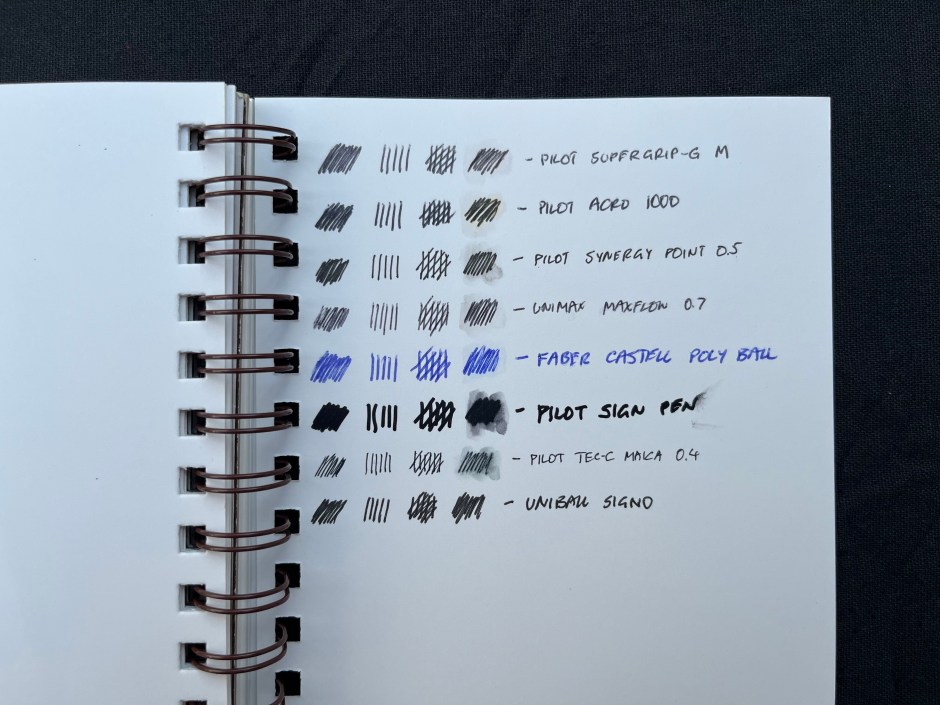
- Pilot Super Grip-G (M)
Accidentally found this in a stationary store in Capri. It’s my new go-to writing pen. Smooth on the page, and a pleasure to write with. It’s a simple ballpoint pen, black.
- Pilot Acro 1000
Was tempted by this pen on the Pilot website on Amazon. It’s totally worth the price! It’s even more smooth than the above pen. Also a ballpoint pen, black.
- Pilot Synergy Point 0.5
This one is hands down the better gel ink pen. Writes with very precise, neat lines. A pleasure to write with. Gel pen, black.
- UniMax Maxflow 0.7
I’ve included this one as it used to be my favorite back at home. I used to draw lots and lots with it. A very cheap pen you can pick up in any stationary store. Ballpoint, black.
- Faber Castell Poly Ball (blue)
I bought this pen in Berlin and I fell in love with how it writes. The ballpoint pen is so thick that it forces me to have different handwriting! The grip is thick but so is the pen point. Rollerball pen, blue.
- Uni Ball Signo
This one was a recommendation sent to me by someone very close and dear. They saw a video on TikTok about a popular pen so I decided to give it a try. It works well on any type of paper, but maybe is a bit too thick for my taste when it comes to writing.
- Pilot Tec-c Maica 0.4
This last one is pure magic. It’s super thin (0.4) and writes so beautifully on all kinds of paper. Downside is also that it’s water soluble. But it’s a pure pleasure to use, I promise.

I’ve included this tester page to show how the pens, well, evidently write. But also to show the thickness and how they react with water.
3. Pens for drawing
When it comes to drawing, for me, it’s about how smooth the pen runs on the page and whether it is water soluble. It also depends on what I’m doing, but the thickness is a big factor as well. Here are some of my favorite pens for drawing in no particular order:
- Lamy fountain pen
Currently, this is my favorite pen for sketching. It lay in my drawer for about a year until I remembered its existence. It creates very fine lines, but does not come with a flexible nib. Love it nonetheless. The only downside is buying the refills. Fountain pen, black.
- Pilot V Ball
For the love of me, I cannot remember where I got this pen and why but it is proving to be irreplaceable for drawings as it doesn’t smudge with water. Another new fave.
- Uni Ball Eye (micro)
This gel pen I use for going on top of watercolors. It creates a thick-ish line but is a pleasure to use. Gel pen, black.
- Pilot Sign Pen
This one is more of a marker, but the pen itself says ‘pen’ so it’s on the list. A very thick, pigmented, black marker pen that is great for writing, drawing, and outlining. It’s so pigmented, that I use it to color in shapes. Downside is that it is water soluble. Marker pen, black.
- Pigma Brush
I got this one as a gift from my husband many many years ago and never knew what to do with it. It’s truly like a brush full of pigment ink. I now use it to create thick lines when I draw. Brush pen, black.

And some of them in action:

4. Watercolors
I’m very flaky with my watercolor preferences. This month you might find me using the Winsor & Newton travel set, and the next day I’ll jump to Van Gogh ones because I recently discovered them again and wanted to give them a second chance. And then I’ll go back to Winsor & Newton but the Cotman ones because that’s a staple.
I’ve spent a lot of time (and money) exploring different brands of watercolors. If you’re interested, I would say Winsor & Newton is a very safe brand to get started with. I hear that the professional line is just exquisite. The ones I own are regular ones, but there’s even fancier options if you’re really into watercolors!
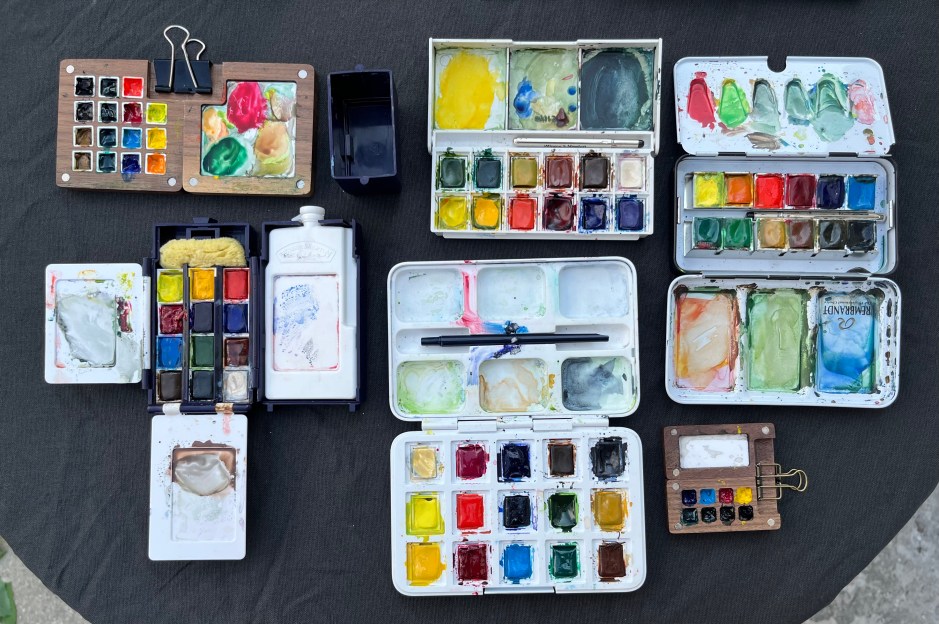
1. Winsor & Newton watercolors (Cotman)
This cute little box the size of your palm has all the primary colors (of course) + white. Although there’s no black, you can easily mix your own. I love this one for how compact it is and easy to bring with you if need be. The colors are quite lovely on any paper, but do tend to be a bit more opaque than some of the other options.
2. Winsor & Newton watercolors (Travel set)
I’m particularly excited to talk about this one because it not only unfolds to have dishes for mixing colors (3 of them) but also has a container for water AND a cup for it. It all disassembles easily and quickly, and is a joy to use. As for the colors, I love that there’s both white and black. It’s neat that there’s purple so you don’t have to mix as many colors. I would say this one is great if you travel and you want to sketch on the go in a peaceful area.
3. Rembrandt watercolors
I used to be absolutely crazy about these watercolors. Considered more ‘professional’, the colors don’t fail to deliver. There’s a really nice array of brown tones, black, and all your primary colors and variations. No white, but I can make peace with that. The colors are very rich on the most smooth paper, and you always get a nice variation when you dilute them with water. 10/10 would recommend. Oh, but they are very expensive, so I just have the smaller sized one.
4. White Nights watercolors
I got these watercolors because they come in tubes. I am not crazy about them, so I use them for the purpose of creating palettes for when I travel or sketching on the go. Tubed watercolors are great in that you can build your own palettes. I wouldn’t recommend this one. Something about the colors just doesn’t click with me.
5. Van Gogh watercolors (pocket box)
Probably my first ‘serious’ watercolors investment. I was in Ukraine when I got these for a whopping amount of money back then. Today, they’re much more affordable. I want to leave a note that I felt a great repulsion to these watercolors. They’ve been collecting dust for more than 5 years in my closet. I got them out to show you a test, and behold! I fell in love with them. Very vivid, clear colors with a lot of pigment. Would recommend it as well if you’re just starting out!

5. Brushes
I buy the cheapest ones. Honestly, I think if you go to any art store, or check out online options, you’ll find that there’s brushes from a few dollars to hundreds. I just get the shape I need, but stick to Faber & Castell for flat brushes and riggers.
My ultimate go-to tools for when I’m working with watercolor are the Pantel watercolor brushes. They’re basically brushes with a container of water, and when you squeeze them, the brush gets wet. They’re great for traveling! You don’t have to bring a container with you for water, and things tend to be quite neat. I just throw one in my bag and I’m good to go with my mini watercolor set. I rarely use regular brushes for this reason. Brush pens are just so convenient. They come in sets of 3 in different sizes so you’re not overwhelmed by choice.

6. Pencils & colored pencils
My two sets of graphite pencils include bruynzeel and Faber-Castell. They both range from HB to 10B between both the sets. I find that that’s everything I need when it comes to graphic pencils. I do have a mechanical pencil from my set design days. I love it but don’t find a use for it nowadays.
With color pencils, I recently discovered Derwent Inktense. Great for sketching purposes and when you don’t have time to wait for paint to dry. The colors are super vivid, unlike the color pencils my daughter uses.
I also have a beloved set of watercolor pencils from Staedtler. I don’t have a strong opinion on them, as I have not learned to use them yet. Whenever I’ve tried, it’s always been slightly a disastrous outcome in my sketches.

Extra recommendations on art supplies:
Still experimenting with these, so I didn’t want to talk extensively about each item. They are all new to my collection and I’m still exploring how I can best use them.
Fine liners: Sakura Pigma Micron
Dip pen + flex nib: Tachikawa & chrome nib Style G (PG 6B C K)
Inks: Winsor & Newton drawing ink
Watercolor markers: From Winsor & Newton
Color sticks: Shuttle Art Tempera paint sticks
Brush pens for tonal work: Tombow
Tips for Choosing the Right Supplies for You
First things first, avoid trends. Avoid the trendy videos you see here and there because it’s not a reliable opinion. Ideally, you want to go out and test these supplies before you buy them but do go for the ones that really excite you.
The thing about high end art supplies is that you can’t just get sample packs and test small before you commit. I suggest researching each individual item and watching some real artists do real reviews of them before making up your mind.
If you feel frustrated with some materials, don’t force yourself to use them. For me, that would be the watercolor pencils. I so badly want to use them, but I just never get the results I’m looking for. It means it’s not for me or it’s not yet time to experiment with them. But that day shall come. Be patient.
My best tip is to probably invest into the items you use most. I have such a wide range of watercolors because it’s my favorite tool for adding color. I don’t go crazy with color pencils or fine liners, I carry one of each that I like a lot. To find what you like a lot, all you have to do is research (or see the materials in person in an arts store and choose something you love).
I also recommend going for the tools that make you want to create, not the best ones on the market necessarily. Rest assured, I can speak about art supplies forever, but if this is a topic you’re passionate about, I encourage going in-person to a really well equipped store and splurging a little.
Rounding things up – I hope you’ve enjoyed my selection of swatches. This was a really fun piece for me to make. I hope you find something truly useful in all this and may you find the supplies that suit you and become your personal staple.
Please sign up to my Substack newsletter to keep up to date with my latest creative adventures, drawings, sketches, and thoughts from my makeshift studio every week.
Discover more from Art + Copy
Subscribe to get the latest posts sent to your email.
 Art + Copy