
Developing a creative habit is no easier than developing any other habit. They say it takes about 21 days. Now, I would argue that this varies from person to person but if you’re committed to doing this for yourself, you’ll get there and it won’t matter how long the road is. The key is commitment.
Why is it important to have a creative habit?
Often times we might feel stuck in life, overwhelmed by emotions, or at that constant battle with our creative side and the many creative blocks that may come our way. A creative habit grounds you. It helps you stay afloat during both good and bad times and gives you a safe space to turn to when you’re stuck.
My theory about the sketchbook technique comes from art school. We were taught to show our work – to think visually in A4 sketchbooks. I’m also very fond of the ‘morning pages’ as described in Julia Cameron’s book “The Artist’s Way” which led me to develop this self-help sketchbook technique using nothing more than a sketchbook with blank pages and a pen.
This technique has helped me get over anything and everything I was feeling, all the while keeping my artistic spirits up. I’m confident that it will work for anyone with any kind of background whether you are a painter, musician, writer, director, someone working in marketing, have your own business (be prepared to get multiple sketchbooks) or a parent, wanting some alone time to make sense of it all. You don’t have to necessarily be a writer or an artist.
Personally, after doing this sketchbook technique of mine for years, I discovered that this spin-off of morning pages and art school sketchbooks has a lot of potential in helping anyone discover a more artistic outlet in their daily life.
The sketchbook technique can help you:
- Keep your thoughts in order.
- Have all your to-do lists at hand.
- Keep track of things (anything and everything).
- Find a creative habit to keep.
- Learn new skills to help you through uninspired times.
We can all benefit from a bit more creativity in our lives. I don’t have any research to prove anything I’m saying, I simply want to share what’s worked for me and my close friends. The sketchbook technique is particularly useful if you feel like you’re stuck in life, lost ambition, can’t get your thoughts in order, or yearn to integrate the arts into your everyday routine.
How to get started with the sketchbook technique:
Step 1: Run to the store to get a sketchbook
If you’re anything like me, you get easily excited at a stationary store. Instead of overthinking about a sketchbook, get a very basic (but nice) one. I am obsessed with Leuchttrum because it is slightly bigger than Moleskine and the ones with blank pages are perfect for using different kinds of medium – pens, pencils, paint, etc.
You can get whatever you like really, but it’s important that the pages are blank.
While you’re at it, explore the stationary store and find the best cheap pen out there so you can write. It’s important that it’s cheap because you don’t want to be intimidated by yet another tool you’re unsure about. You can always run back to the store and get a different pen if you’re not feeling your cheap one. If you’re feeling good about this, buy a few pens you like! The more the merrier.
Step 2: Stare at the blank pages
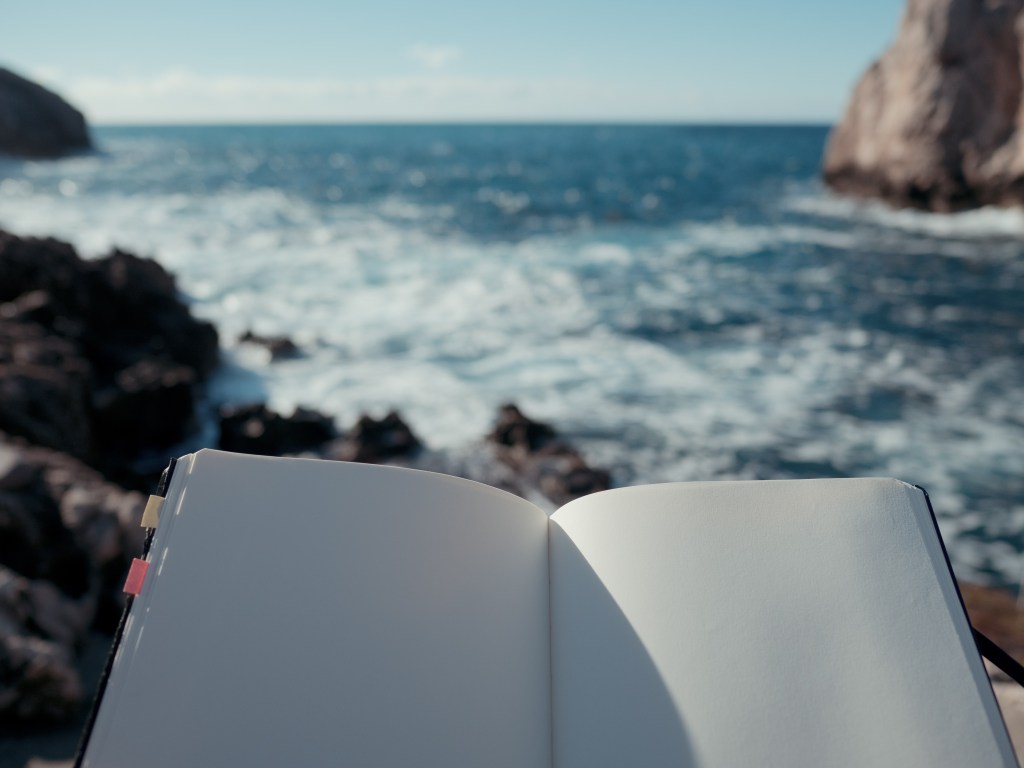
You ever hear about how artists are intimidated by a blank canvas? Well, you will probably be intimidated by your new sketchbook. Flip through the pages, explore the craftsmanship that went into this piece of artwork (even if you got something really simple). Learn to get over the intimidation by continuing to the next steps.
Doodle with your new pen!
Staring at blank pages might inspire something in you. Does something come to mind right away that you want to write down? Do it. Get excited about starting something new and starting something from scratch.
Step 3: Start writing, but start small
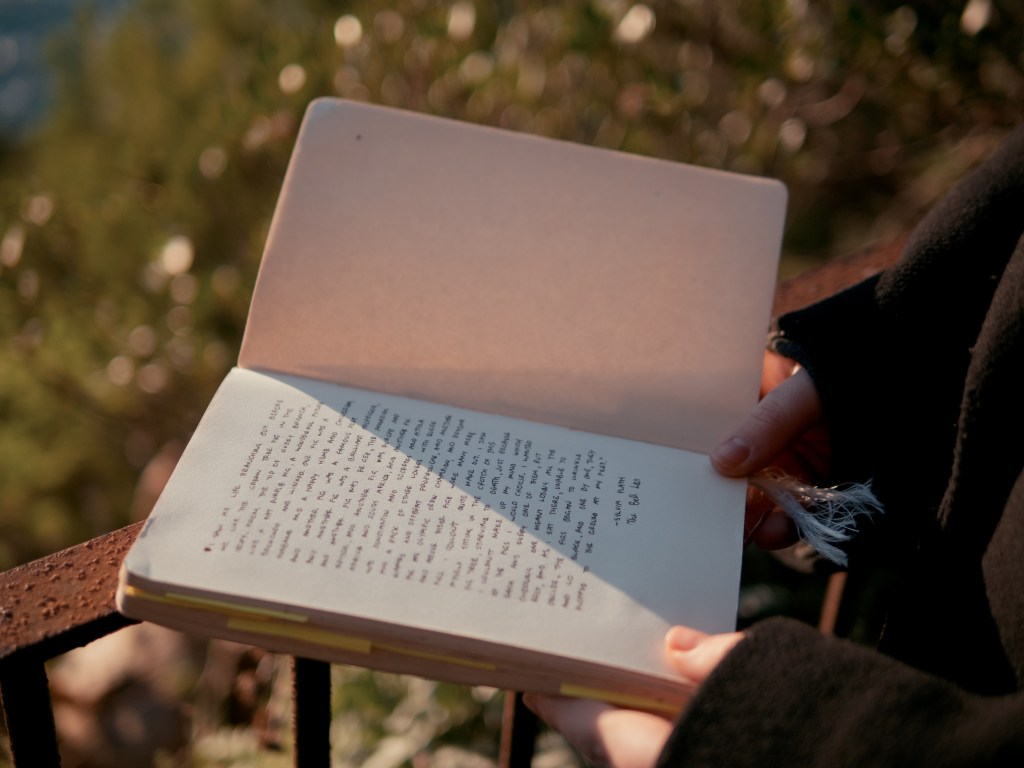
I’ve mentioned that you don’t have to be a writer or an artist. This is how you start: test your pen. Doodle a small square with zigzag lines. If you have several pens, try to test them on the first page. Figure out how the flow of the ink suits your writing style. Jot down some words. Recall your favorite quote and put it down on that first page as well.
Not feeling like going all out right away? Write the day’s date. Do it in a column on the right or on the left, in the middle of the page, in the second half, or right at the top. Do what feels right and natural to you. Just get the date down. Next, write down some notes from the day you had.
You can also do a short paragraph stream-of-consciousness style right away about how you feel with this new endeavour of yours. Clean your cluttered mind. (Please don’t mention me and how you blame me for your splurge at the stationary store).
Step 4: Turn the page and turn to this list of ideas
There are a million things you can write about next. Here are a few of them:
- How you felt on this particular day
- A list of books you want to read
- A list of movies you want to watch
- A list of places you want to visit
- Lectures you want to listen to
- Courses you want to do
- A shopping list
- A to-do list
- Reminders
- Quotes
- Your plans and hopes for the future etc.
Ah, you’re probably wondering “Why?” I’ll tell you that there is definitely something about putting pen on paper that just makes your brain work differently. Julia Cameron is more articulate about this but my take is that it gives you the peace of mind to slow down your rushing thoughts and focus on self reflection. Even if you’re writing lists like I suggested – pen on paper is magic.
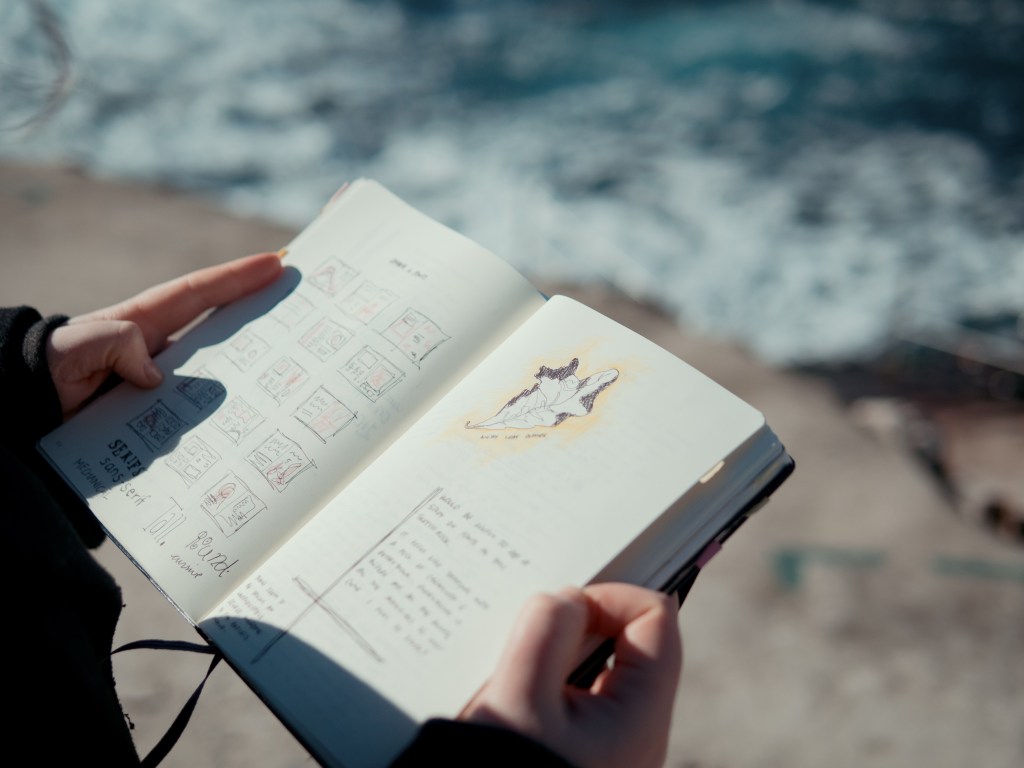
Pen on paper makes you slow down. And that’s a good thing! We live in such fast-paced times. Think about the last time you sat down to do anything like this. The objective is to find a new outlet for you, creatively speaking. Or:
The goal is to learn to make your mind work on paper.
Again, “Why?” Because anytime you feel stuck in the future, you’ll be able to turn to these blank pages full of hope and aspiration. Sometimes, if you’re lucky, you’ll even be able to find answers.
With time, you become more articulate with words. The more articulate you become, the more you’ll begin to learn about yourself and your superpower. Being articulate is probably the biggest secret weapon in today’s society. Make writing a habit. Commit to it everyday.
If nothing happened on that day, you still thought things didn’t you? Write down what you were thinking. And this is just the writing aspect of this sketchbook technique.
But you got blank pages for a reason, right?
Step 5: Next level – Master new techniques
I have a bit of a sad story with art school – it left me empty and in debt. I wanted to learn to be a better artist but instead I was basically sent to the library with the words “learn to do it yourself”. That was hard for me to make peace with, but it ended up being my motto – I’ll just do it myself.
When it comes to your sketchbook, did you know that you can quickly learn to draw? One of the most life changing books for me was “The Creative License” by Danny Gregory. It’s an old one, and I’m a bit shy about giving away this great treasure to you.
“The Creative License” – I loved it from page 1.
The premise of the book is that absolutely anyone can draw – which includes you. Danny Gregory teaches you to see, not to draw. In learning to see, you’ll discover that you can sketch absolutely anything and everything if you set aside some time for it (even before breakfast, as he claims).

How it all comes together
So there you have it. You surely have it in you to write, and with a little bit of help you can learn to sketch. Sketching is a whole other pleasurable world where you immediately feel more artistic and more equipped to make your days more meaningful, even the most mundane ones.
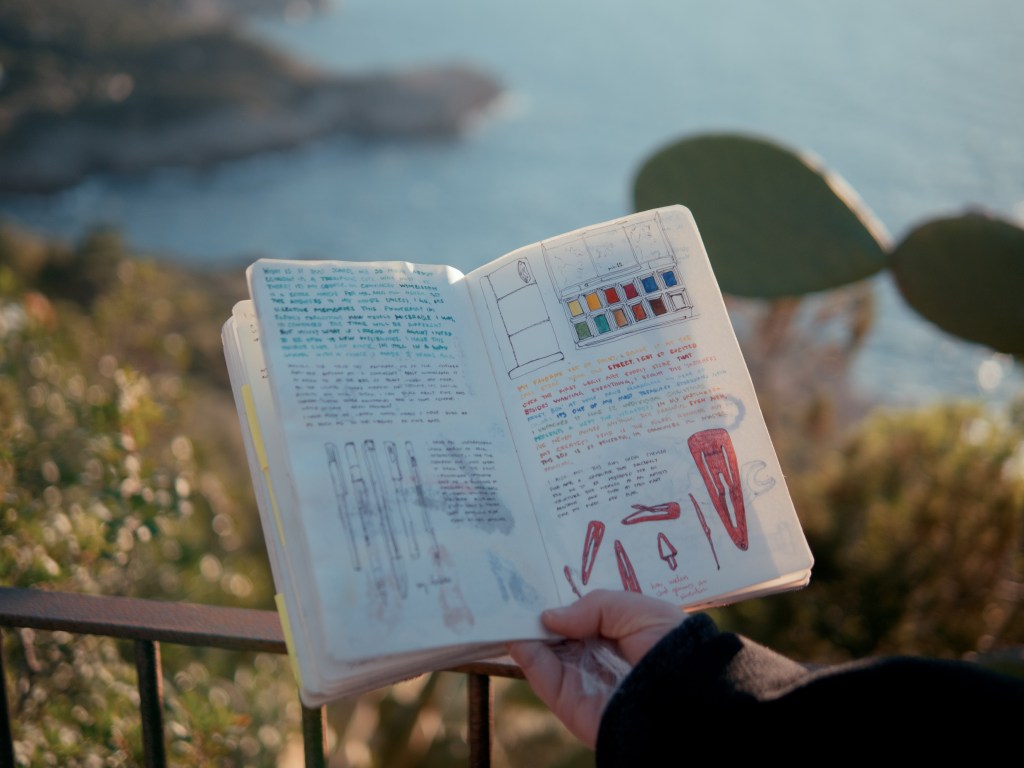
An important rule of the sketchbook technique is that it goes wherever you go. This can give you ideas on the spot, things you want to jot down or sketch on the go whenever you have a free minute.
Remember, the sketchbook goes wherever you go.
Let me give you another big benefit of all this. Can you remember what you did 1 year ago on this exact day? I can. I can flip back to my sketchbook from 2020 and read that 1 short paragraph about my mid-life crisis in the middle of a pandemic.
You can give more sense to your days by keeping track of them this way, away from the digital noise, away from distractions, away from the hassle and the bombardment of information we get when we open our laptops. If anything, it’s worth a try, no? For me personally, my sketchbook substituted the need for a shrink. But I’d argue that that’s a unique case.
A few more tips
Get rid of misconceptions about writing by the way. You can use the whole page in a day to write and sketch, or a few, or none at all. Skip a day, do it everyday, but always keep it in the back of your mind. Write down something every day. Start with the date and go from there.
Bored? Open your sketchbook and let the blank pages speak to you. There’s always something going on in your mind which means there’s always something that can be put down in your sketchbook.
The joy of collecting stuff
At some point I became obsessed with time and memories. I kept things in my sketchbook – artsy tickets, postcards, bookmarks, small photos. Anything and everything goes! You have to find a way to make it your own, and there’s no guide for this. But it’s a really good feeling when your sketchbook fills up with ‘stuff’ and memories of specific days.
Surely you must be doing your math now and asking yourself how many sketchbooks that would make if you keep at it. For me, I go through about one a year (give or take, and there are some days I don’t write). And that’s a good benchmark. It might be different for you and that’s totally fine as well. Don’t limit yourself and don’t go too crazy.
If you’re getting really into sketching or painting or collecting stuff, you’re probably seeing a consistent pattern. Get a separate notebook or sketchbook for it. Remember that at the base groundwork of this sketchbook technique is writing – good old pen on paper stream of consciousness. It’s been proven to work.
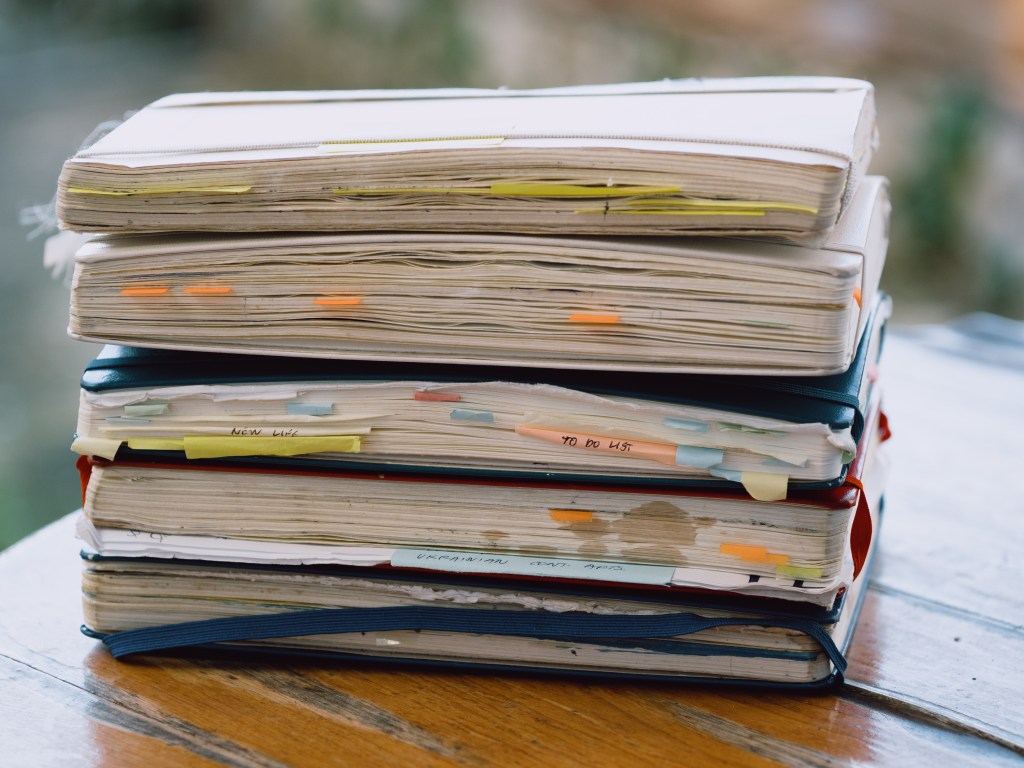
Examples of sketchbook pages I have
- One with just a stream of consciousness writing of what happened that day
- A breakdown of everything I did on a specific day by time
- Post its with a list of Christmas gift ideas for the family
- A sketch of my photographs to be made into paintings
- Postcards from Naples, taped so I can write below the postcard to save space
- Tickets from my last trip on the ferry with memories around it from that day
- Two pages of a magazine, cut to fit my sketchbook with writing on top of the clipping
- A drawing of a famous amulet that I bought with my recollection of a special day on which I got it
- A page with a poem my husband wrote for me
- A page with a printed photo and my project idea next to it on the next page
- A page that is a test of all my pens and pencils with side notes on how I’d like to use each one for writing and/or drawing
- Pages and pages of memories from my childhood
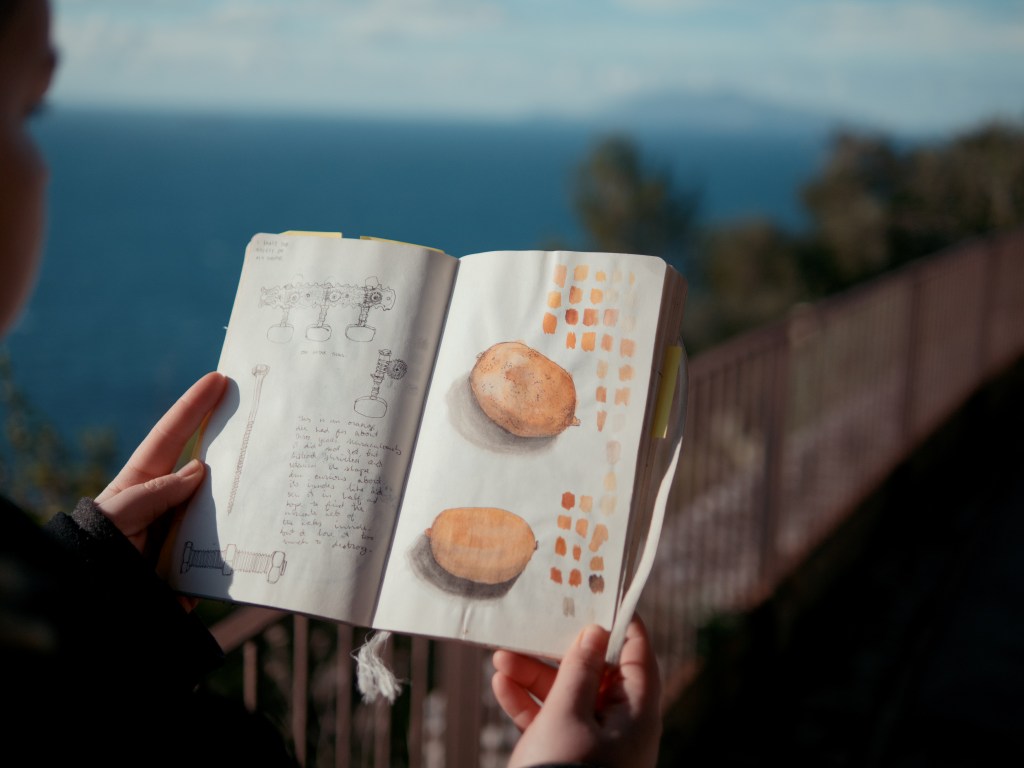
And in this way, your sketchbook with blank pages flourishes into a canvas with artworks that take shape through writing and drawing. Some venture into painting and glue the watercolor pages down to remember that specific day. Some save clippings so nothing goes to waste – the possibilities are endless.

Your sketchbook becomes an extension of you
If you carry your sketchbook around with you to also keep track of all your ideas, you know that everything is always going to be in one place. The sketchbook is you. Your mind. Your worries, concerns, hopes, dreams – it will all be there for you to revisit one day.
Glue things in the sketchbook, bookmark pages, stick things down with tape, write over photographs, paintings, postcards, clippings. Jot down quotes from a book, jot down memories from the past, reflect on your aspirations for the future. Anything and everything goes. You’ll develop your own technique as you go along.
This is the foundation and the groundwork for developing a creative habit. And the benefits of that are many. Simply observe the world if you have nothing to say. It’s a vast, huge rock in space full of opportunities.
Lastly
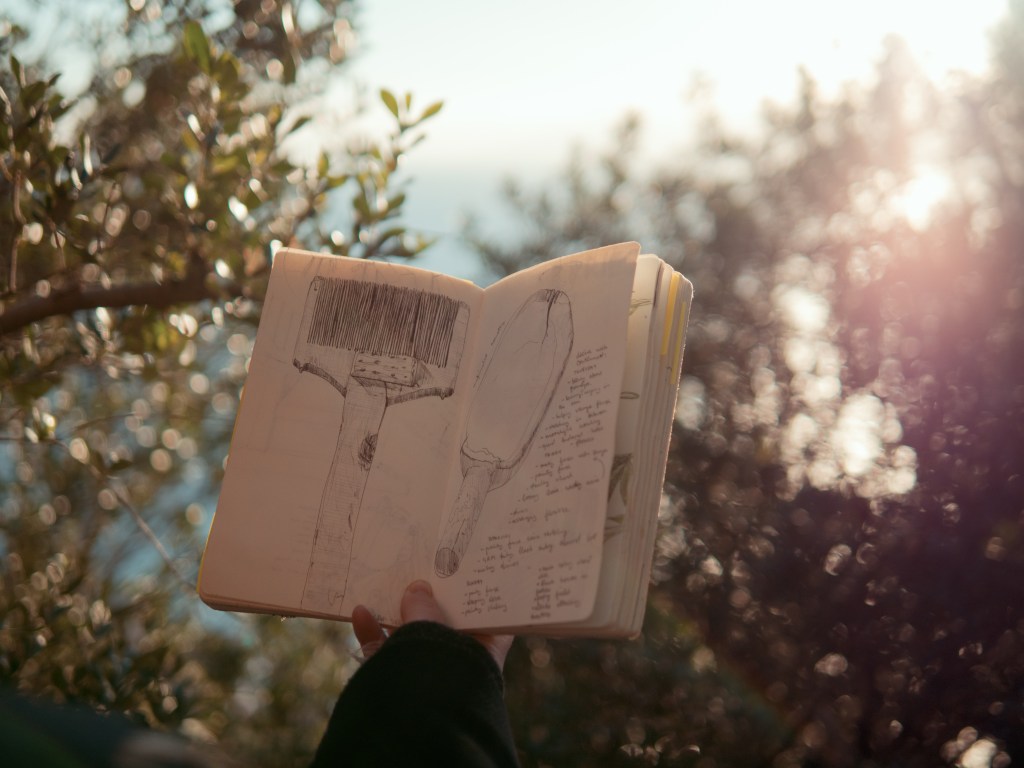
When the pandemic started, I came back to my sketchbook after almost a year’s break. It provided a safe space when I was stuck at home. I was able to vent my frustrations, get my thoughts down on paper. And you know what? I felt so much better after writing things down. I hope it works the same way for you. I hope you find that big magic.
A blank canvas can be intimidating but my best advice is to just sit down and do it. Just try.
If you’re not articulate or particularly artistic – all the better. Challenge yourself and you’ll acquire new skills in the process. In doing this, you’re likely going to stumble on an ocean of new opportunities with new readings and new things you want to do in life. This sketchbook is just the beginning. You are slowly forming a creative habit to accompany you throughout the years.
Discover more from Art + Copy
Subscribe to get the latest posts sent to your email.
 Art + Copy